


Is Tallow Balm Good for Sensitive Skin? A 2026 Guide

Table of Contents
- Is Tallow Balm Good for Sensitive Skin? The Short Answer
- Benefits of Grass-Fed Tallow for Face: Barrier Support and Beyond
- How to Patch Test Skincare Before Committing to Tallow Balm
- Is Tallow Balm Safe for Eczema and Rosacea-Prone Skin?
- Comedogenic Rating, Pore Clogging, and the pH Question
- Processing Methods and Ingredient Synergy: What Separates Balms
- Common Mistakes That Make Tallow Balm Irritate Sensitive Skin
- Conclusion: Choosing a Tallow Balm for Reactive Skin
- Frequently Asked Questions
Last Updated: October 7, 2026
Is Tallow Balm Good for Sensitive Skin? The Short Answer
Yes, tallow balm can work well for sensitive skin, but only when it is made well and tested carefully. The answer depends less on the tallow itself and more on what sits beside it in the jar. At Olivée Beauty, we built our Advanced Tallow Balm around that idea: a short, skin-compatible ingredient list matters more than a trendy label.
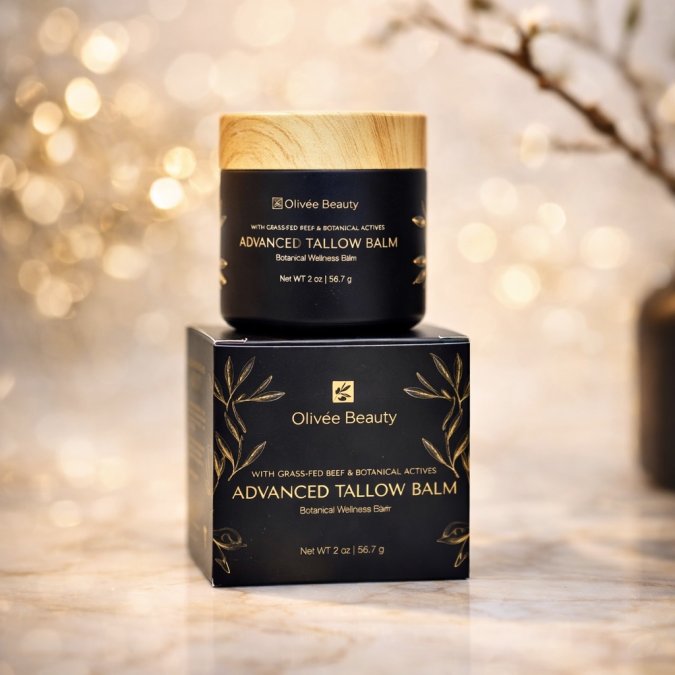
Sensitive skin can react to many factors, including individual sensitivities and specific ingredients within a formula. Rather than judging a balm by tallow alone, consider the complete formulation, how it is processed, and how your individual skin responds..
So the real question is not “is tallow balm good for sensitive skin” in general. It is whether a specific balm is thoughtfully formulated, well-processed, and suited to your skin
What Tallow Balm Actually Is
Tallow balm is a waterless skincare product made from rendered beef fat, often mixed with oils, butters, and sometimes active ingredients. It contains no water, so it needs little or no preservative.
That matters for reactive skin. Water-based creams need preservatives to stay stable; a waterless balm skips that step and relies on fat to seal in moisture and support the skin's outer layer.
Tallow comes from grass-fed cattle. It is a rendered fat, melted and purified before use, resulting in a dense, emollient balm rich in fatty acids that mirror the lipids your skin already makes.
Why Sensitive Skin Reacts Differently
Sensitive skin has a weaker barrier. When it thins, moisture escapes and irritants slip in. This is called transepidermal water loss, and it drives redness, tightness, and stinging.
A healthy barrier depends on lipids. Two fatty acids matter most here:
- Oleic acid: softer and more fluid, but it can feel heavy on some skin
- Stearic acid: firmer and more occlusive, helping seal the surface
Tallow contains both. That balance is why many people with dry, reactive skin find it calming. But the same richness can clog pores or trap irritation if the balm is poorly made. The American Academy of Dermatology's guidance on sensitive skin care notes that fragrance and harsh ingredients are common triggers, not the base oils themselves.
Benefits of Grass-Fed Tallow for Face: Barrier Support and Beyond
Grass-fed tallow offers real upside for dry, sensitive faces. Its fatty acid profile supports the lipid barrier, the skin's first line of defense. When that barrier works, skin holds water better and looks calmer.
The benefits of grass-fed tallow for face come down to a few things:
- Barrier repair: lipids fill gaps in a compromised barrier
- Deep moisture: occlusive fats slow water loss
- Vitamin content: tallow carries fat-soluble vitamins A, D, E, and K
- Emollient feel: skin feels softer and smoother, not greasy
Those vitamins are bioavailable, meaning the skin can use them. Vitamin A supports cell turnover. Vitamin E and vitamin K act as antioxidants. None of this is a miracle cure, but it is solid, steady nourishment.
Fatty Acid Profile and the Lipid Barrier
Tallow's fatty acids sit close to the ones in human skin. The closer a balm's lipids match your own, the more easily your barrier accepts them.
Oleic acid softens and stearic acid protects. A good balm balances both, then adds supporting oils like squalane or jojoba to fine-tune the feel.
This is where ingredient synergy matters. Pairing tallow with skin-compatible lipids and soothing botanicals makes the formula work harder without adding irritation.
How to Patch Test Skincare Before Committing to Tallow Balm
Learning how to patch test skincare takes two minutes and saves weeks of regret. Never apply a new balm to your whole face first.
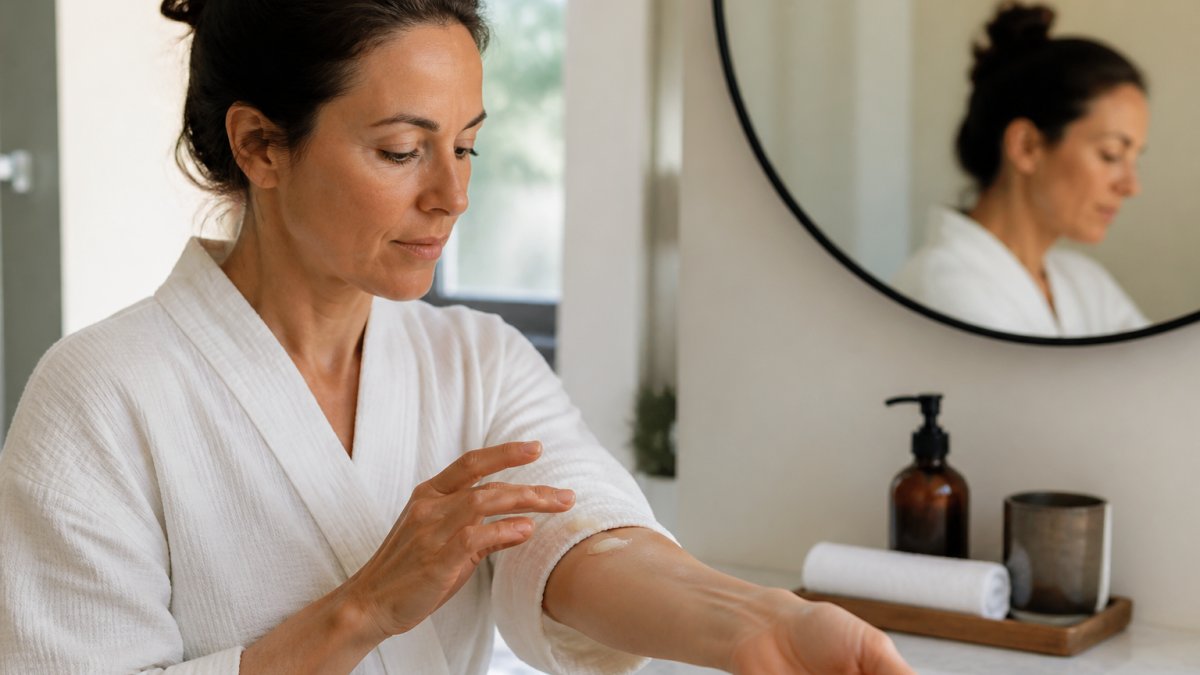
Here is the process we recommend:
- Wash and dry the inside of your forearm
- Apply a pea-sized amount to one small spot
- Leave it uncovered for 24 hours
- Check for redness, itching, or bumps
- If clear, repeat on a small patch behind your ear
- Wait another 24 hours before using it on your face
If you see a reaction, stop. Most irritation shows up fast, though a slow reaction over days is possible, so keep watching.
Is Tallow Balm Safe for Eczema and Rosacea-Prone Skin?
Tallow balm can be safe for eczema and rosacea-prone skin, but it is not a treatment. It supports the barrier; it does not replace a doctor's care. If your skin is cracked, weeping, or badly inflamed, see a dermatologist first.
For mild, dry eczema, a rich occlusive balm can reduce water loss and ease tightness. The National Eczema Association's overview of moisturizing and skin care stresses that keeping skin moisturized is a core part of daily eczema care. A simple, fragrance-free fat fits that goal well.
Rosacea is different. It is driven by inflammation and triggers like heat, spice, and stress. A gentle balm may calm dryness, but it will not stop a flare. Patch test first, and avoid synthetic fragrance or strong essential oils.
One honest limitation: tallow is not hypoallergenic for everyone. Some people react to it. That is why testing matters more than marketing claims.
Comedogenic Rating, Pore Clogging, and the pH Question
Comedogenicity cannot be predicted reliably from tallow alone. How a finished balm behaves depends on the complete formulation, the amount applied, and the individual skin type. People with oily or acne-prone skin may prefer a very thin application and should monitor how their skin responds..
The rating comes down to fatty acid ratios. Oleic acid is the more comedogenic of the two main fatty acids in tallow, and stearic acid the less comedogenic one.
Here is what most guides miss about pH. The acid mantle, your skin's slightly acidic surface film, sits around pH 4.5 to 5.5. That number matters for water-based products because water carries dissolved ingredients that can shift surface pH.
Pore clogging is the concern worth managing. A few habits help:
- Use a thin layer, not a thick scoop
- Apply to damp skin to spread it further
- Skip heavy layers on oily zones like the T-zone
- Watch for clogged pores over the first two weeks
- If you are acne-prone, look for a formula that lists squalane or jojoba ahead of heavier butters
If you break out, scale back. Rich balms are not for everyone, and that is fine.
Processing Methods and Ingredient Synergy: What Separates Balms
Two tallow balms with the same label can behave very differently. Processing and ingredient pairing decide which one your skin tolerates.
There are three main ways tallow gets rendered, and they are not interchangeable:
- Wet rendering boils fat with water, then separates the layers. It is the gentlest heat exposure, but if the water is not fully driven off, trace moisture remains and the balm needs a preservative or risks going rancid.
- Dry rendering melts fat slowly in its own liquid at low heat, then strains it. It produces a clean, shelf-stable fat with no added water, which is why most waterless balms use it.
- High-heat or industrial rendering uses fast, high temperatures to maximize yield. It is cheap and fast, but the heat can oxidize fragile fatty acids and strip fat-soluble vitamins A, D, E, and K. The result often smells stronger and feels tackier.
A clean, well-made tallow smells mild, not rancid or beefy. If a balm smells sharply of beef or has a yellow-orange tint, the fat was likely over-heated or under-purified.
Ingredient synergy is the other half, and it is where most sensitivity actually originates. Essential oils like lavender, citrus, and peppermint are common in tallow balms and among the most frequent contact irritants.
This is the gap between a basic balm and a refined one. Rather than judging a balm by ingredient count alone, consider the purpose, compatibility, and balance of the complete formulation.
Our Advanced Tallow Balm uses 25.9% grass-fed tallow with squalane, jojoba, and shea butter. It adds bakuchiol and tetrahexyldecyl ascorbate, two actives you would normally find in a serum. The result is one concentrated step instead of many.
Common Mistakes That Make Tallow Balm Irritate Sensitive Skin
Skin reactions can depend on individual sensitivity, the complete formula, the amount applied, and how a new product is introduced into a skincare routine.
- Skipping the patch test: the fastest way to a bad reaction
- Applying too much: a thick layer can clog pores and trap heat
- Layering over actives: acids and retinoids plus a rich balm can overwhelm skin
- Choosing scented balms: synthetic fragrance is a top trigger for sensitive skin
- Ignoring a reaction: if it stings or itches, stop, do not push through
- Buying on hype alone: cheap fillers and additives undo the benefits
A common mistake is treating tallow balm as a cure-all. It is a moisturizer and barrier support, not a fix for every condition. Set realistic expectations and give your skin time.
Conclusion: Choosing a Tallow Balm for Reactive Skin
Sensitive skin does not have to fear tallow balm. It just has to be choosy. Look for a short ingredient list, gentle processing, and no synthetic fragrance. Then patch test before you commit.
That is the standard we hold at Olivée Beauty. Our Advanced Tallow Balm pairs grass-fed tallow with skin-compatible lipids and modern actives in one waterless step. It supports the barrier, deeply moisturizes, and softens the look of dryness without a ten-step routine.
If your barrier feels tight, red, and reactive, start simple. Get started with Olivée Beauty and give your skin one concentrated formula built to calm and support it.
Frequently Asked Questions
Why don't dermatologists like tallow?
The skepticism usually isn't about tallow itself but about how many balms are made. Unrefined rendered fat can carry impurities, and some products add essential oils or synthetic fragrance that trigger irritation. Tallow is also occlusive, so on acne-prone skin it can trap debris. A purified, fragrance-free formula with a short ingredient list removes most of the risk dermatologists flag, which is why patch testing and reading the label matter more than the fat source.
Does tallow balm clog pores for sensitive skin types?
Tallow does not affect every skin type the same way, and pore-clogging potential cannot be determined by one ingredient alone. The complete formula, amount applied, and individual skin type all matter. If you have oily or acne-prone skin, start with a very thin layer and monitor how your skin responds.
What should eczema-prone skin consider before using tallow balm?
Eczema is a medical condition, and tallow balm is not a treatment for it. Because eczema-prone skin can be highly reactive, patch test any new skincare product and avoid introducing new products during an active flare. If your skin is inflamed, cracked, or worsening, consult a dermatologist or healthcare professional..
How often should you use tallow balm on your face?
Most sensitive-skin users do best with once nightly to start, applied to damp skin after cleansing so the balm seals in water rather than sitting on dry skin. If your barrier feels tight or reactive, use it every other night for the first two weeks. You can add a morning application once your skin settles. More frequent use isn't better; a pea-sized amount is enough for the full face and neck.